The Magnesium Miracle (Revised and Updated) by Carolyn Dean M.D. N.D
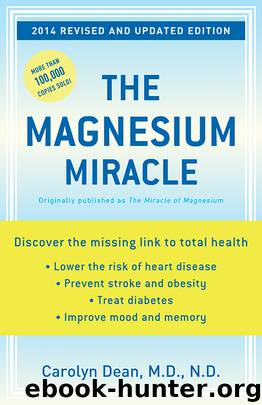
Author:Carolyn Dean, M.D., N.D. [Dean, Carolyn]
Language: eng
Format: epub
ISBN: 978-0-307-55769-8
Publisher: Random House Publishing Group
Published: 2014-03-04T05:00:00+00:00
SPASTIC HEART
Between 40 and 60 percent of people who suffer sudden heart attacks may actually have no arterial blockage or history of irregular heartbeats.34 Two suspected causes are spasms in the coronary arteries and the occurrence of a severe heart rhythm disturbance, such as atrial fibrillation. Both of these conditions can be caused by a deficiency of magnesium. Low magnesium makes the heart muscle hyperirritable, leading to the development of a rhythm disturbance that can’t be stopped without emergency medical intervention. An astute physician recognizes the possibility of magnesium deficiency and immediately gives magnesium intravenously, as in the LIMIT trial. Rapid heartbeat or atrial tachycardia, premature beats, and atrial fibrillation have all responded to treatment with IV magnesium.35, 36, 37
The most common time for the onset of heart attacks is around 9 A.M. on Mondays as people gird themselves for another long workweek.38 As mentioned earlier, people who suffer from spasm-induced angina attacks most often experience them at the same time each day, usually in the morning and late afternoon, when magnesium levels are at their lowest. The morning deficiency is likely the result of overnight fasting and the loss of magnesium through the urine. Deficiency in the afternoon may be caused by depletion of magnesium induced by the stress of the day and not yet replenished by the evening meal. In view of this, it seems reasonable that people with angina, heart spasms, hypertension, or heart disease should consult with their doctors and take a Magnesium RBC test; if it is below optimum (6.0 mg/dL), they could gradually work up to 125–250 mg of magnesium taurate or ½–1 tsp picometer magnesium 3 times per day—before breakfast, at 2 p.m., and before going to bed.
Download
This site does not store any files on its server. We only index and link to content provided by other sites. Please contact the content providers to delete copyright contents if any and email us, we'll remove relevant links or contents immediately.
Nutrition for Sport, Exercise, and Health by Spano Marie & Kruskall Laura & Thomas D. Travis(3787)
Nutrition for Sport, Exercise, and Health by Marie Spano & Laura Kruskall & D. Travis Thomas(3734)
The Sprouting Book by Ann Wigmore(3593)
Flavor Flours by Alice Medrich(2868)
Superfood Smoothie Bowls: Delicious, Satisfying, Protein-Packed Blends that Boost Energy and Burn Fat by Chace Daniella(2485)
Memory Rescue by Daniel G. Amen(2426)
Dirty Genes by Ben Lynch(2318)
The Bad Food Bible by Aaron Carroll(2275)
Genius Foods by Max Lugavere(2222)
The Poisoner's Handbook by Deborah Blum(2143)
Good Calories, Bad Calories by Gary Taubes(2113)
The Main Street Vegan Academy Cookbook by Victoria Moran(2089)
The I Quit Sugar Cookbook by Sarah Wilson(2042)
Core Performance Essentials by Mark Verstegen(2015)
Memory Rescue: Supercharge Your Brain, Reverse Memory Loss, and Remember What Matters Most by Amen Dr. Daniel G(1980)
Big Girls Do It Stronger by Jasinda Wilder(1964)
Android App Development by Franceschi Hervé J.;(1845)
Sugar Crush by Dr. Richard Jacoby(1801)
Dr. Colbert's Keto Zone Diet by Don Colbert(1654)
